TECHNOLOGY · SWING
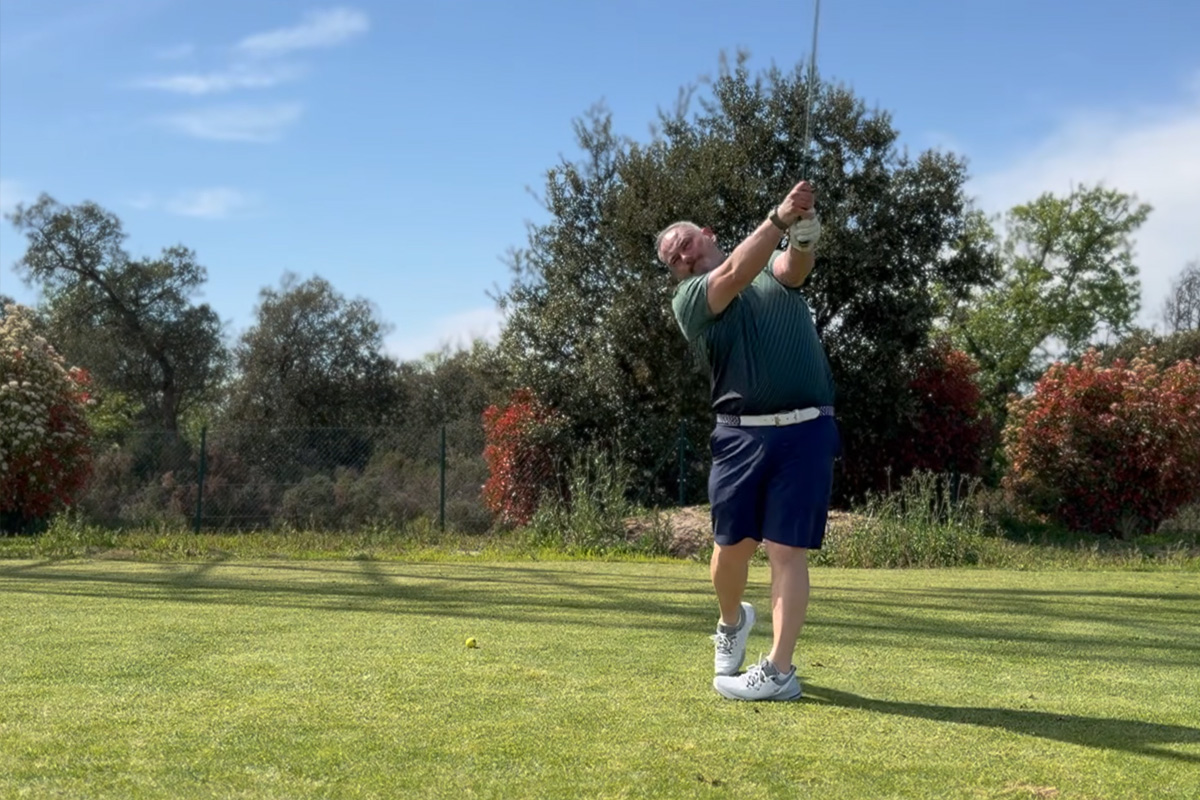
Senior-Friendly Punching Technique — What changes after 60 (and what doesn't).
The classic golf swing is not unsuitable for seniors. But from age 60 onwards, it requires three structural adjustments that hardly any coach explicitly makes. What biomechanics really says — and where standard senior tips do more harm than good.
MAt 64, I changed coaches. My long classic swing was replaced by a supposedly „senior-friendly” compact variant: shorter backswing, more hands, less hips. Six weeks later, my score was 5 strokes worse, my shoulder hurt, and I understood: a senior swing isn't less swing, but a differently structured swing. The shortening was the problem—not the solution.
The classic „senior tips”—shorter swing, more hands, less hip rotation—are mostly biomechanically counterproductive. MyTPI research and Kelvin Miyahira analytics have shown for years: senior golfers don't need less movement, but rather better structured movement. The adjustments that really work are less spectacular than the marketing—and that's precisely why they've been working for twenty years.
What biomechanically really changes from age 60
Three swing adjustments that really work from age 60
There’s no such thing as a senior golf swing. There’s only good biomechanics and bad biomechanics—and seniors have less margin for error with bad biomechanics than younger players.
— Dr. Greg Rose, Co-founder of the Titleist Performance Institute (MyTPI)
Three Principles That Distinguish Truly Senior-Friendly Technology from Marketing Gimmicks.
Mobility beats shortening
The classic senior tip „shorter swing” treats the symptom, not the cause. Daily hip, thoracic spine, and shoulder mobility restores full range of motion – and with it, distance that a compact swing could never deliver.
Setup stability beats dynamics
Young players compensate for an unstable setup with dynamic athleticism. Senior golfers cannot do that. A stable base at address and a quiet setup phase are the most important technical requirements in senior golf – more important than any swing mechanics detail.
Efficiency beats maximum
Maximum clubhead speed decreases with age — efficiency does not. Smash factor, spin loft balance, clubface control: all trainable, all available from age 60 onwards. Those who swing for efficiency instead of maximum score measurably better — and spare their joints.
On this page
What technical work cannot replace
Three swing adjustments are the most sustainable technical score levers — but they neither replace mobility work nor short game routine. Those with perfect swing technique who play wedges poorly and do not follow a daily mobility program are forfeiting the greater part of the possible score advantage. Technique is the prerequisite — not the entire game. It only takes effect in combination with body-first training and short game discipline.







 German
  English