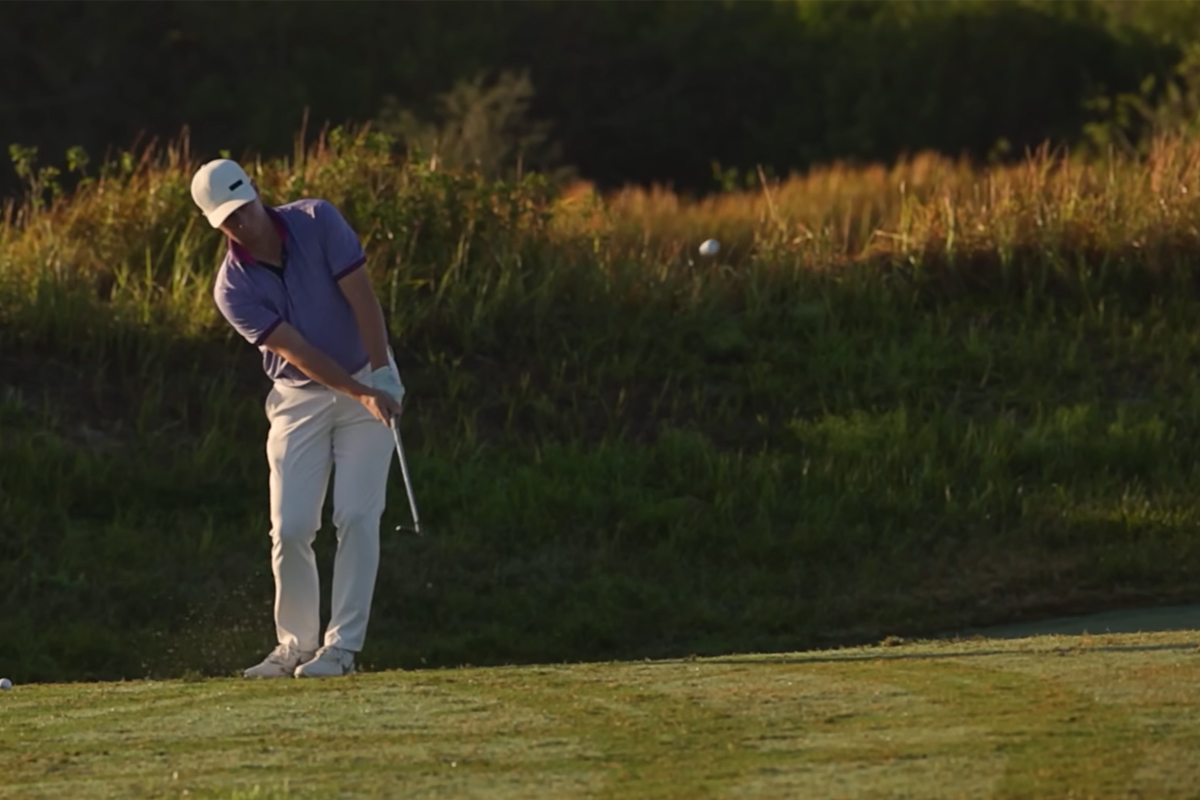
Driver technique for 60+ doesn't mean „swing shorter.” It means adapting your equipment to a lower swing speed and changing your Angle of Attack. The classic 9° drivers found in many senior golf bags come from a time when buyers purchased based on tour images – at 105 mph clubhead speed, 9° is optimal. At realistic senior swing speeds between 75 and 90 mph, the spin with 9° is often no longer sufficient, the ball drops early, and distance is lost. Those who understand this physics can realistically gain back five to ten meters of carry – without loss of mobility, without speed training, without new coaching.
Three driver factors that change with age
Factor 1 - Spin loft tips at lower speed
Too little backspin.
Backspin keeps the ball in the air. At clubhead speeds under 90 mph, a 9° driver often produces only 1,900 to 2,200 rpm – the ball loses hangtime and distance early. The optimal range for senior speed is more like 2,400 to 2,800 rpm. This is achieved with two to four degrees more loft – depending on the individual impact.
Factor 2 — Angle of Attack increasing
✓ +3 BIS +5° AT THE DRIVER.
Unlike with irons, the driver should hit the ball on the upswing. In practice: higher tee position (ball equator approximately level with the driver crown), ball position forward (for right-handers, approximately level with the inside edge of the front foot), slight backward tilt. This is not a change-over task—this is setup.
Factor 3 - Smash Factor before Speed Maximum
✓ MIDDLE GROUND IS BETTER THAN ANYTHING.
The smash factor (ball speed ÷ clubhead speed) describes striking quality. A center hit at 85 mph demonstrably produces more ball speed than an off-center hit at 92 mph. Target value: over 1.45 with the driver. Striking quality is a more important lever than pure speed in the senior years.
Three direct-impact adjustments
Fitting 1 — Custom-Fitting with Launch Monitor
100–200 €.
Fitting with a PGA pro or an independent fitter (not a brand-name fitter whose results are predetermined). Loft, shaft flex, and shaft length adjusted to your clubhead speed and angle of attack. The most important factor for improving your score when purchasing a driver. A home launch monitor like the Garmin R10 is useful for subsequent checks but doesn't replace the initial diagnosis.
Adjustment 2 - Tee higher, ball forward
Free.
When the ball's equator is at the level of the driver's crown, the height is suitable for an ascending impact. For right-handed players, the ball position should be approximately on the inside edge of the front foot. These two changes cost nothing and have an immediate effect—try them before the next round, not later.
Adjustment 3 — 80 Percent Swing
Rhythm before maximum.
For most senior golfers, an 80-percent swing produces more carry than a full swing. Reason: better ball-striking (higher smash factor), less dispersion, smoother impact. Mental image: „smooth” instead of „hard.” The proof comes from the launch monitor: hit 10 balls at 80 % and 10 balls at 100 %, then compare the median carry. As a rule, the 80 % shots come out on top—often by a surprisingly large margin.
Distance is not the same as power. Young players need power. Senior players engineer distance through equipment, attack angle, and quality of contact.
— Tom Wishon, custom club designer and author of The Search for the Perfect Golf Club
Three principles for choosing a driver as of age 60.
Loft beats speed
Higher loft (10-12° depending on speed) compensates for lower clubhead speed with more backspin and a higher trajectory. A realistic speed increase through training is one to three mph—a loft change often brings more yards, immediately.
Quality engagement beats distance marketing.
A smash factor above 1.45 is more valuable than any marketing distance. Those who hit the center gain yards without exerting more force. Most senior golfers don't hit the center because the equipment doesn't fit, not because they are weak.
Fitting beats model.
A year-old or two-year-old driver with a suitable senior shaft outperforms the premium new model with a standard shaft in practice. The leverage is in the fit, not the model year.
Common Misconceptions and Marketing Traps
Misunderstanding 1 — „Printed loft is real loft”
Incorrect. Printed driver loft specifications are not standardized — the actual loft angle can vary by up to one degree between different brands, even within the same model line. „10.5°” from Manufacturer A is not the same as „10.5°” from Manufacturer B. Test on a launch monitor before making a purchase decision, not based on the printing.
Misunderstanding 2: „A new driver adds 20 meters”
Grossly exaggerated. The realistic distance difference between two current driver generations is two to five meters – with a perfect fit and identical swing. Advertising claims with significantly higher distance gains combine several effects (new shaft, different head shape, new setup) and suggest that the novelty itself brings the leap. The actual gain almost always lies in the fitting setup.
Misunderstanding 3 – „Adjustable hosels solve the loft problem”
Only partially. Adjustable hosels allow loft changes of ±1 to ±2° — practical, but limited. If you change a 9° driver to 11°, you simultaneously change the face orientation; the ball tends to fly to the left (for right-handers). The adjustable option doesn't replace proper fitting; it only helps with minor adjustments.





 German
  English