EQUIPMENT · CRITICALLY TESTED

The 5-wood — the senior all-rounder.

The 5-wood is the most versatile fairway club in a senior bag—fairway, rough, long par 3s, par-5 layups. Manufacturer catalogs are dedicating less space to it because hybrids bring more profit. What the 5-wood really delivers, where a hybrid or 3-wood is better, and which shaft costs the 10 yards nobody mentions.

The 5-wood belongs in the senior bag – for most players. Loft between 18 and 20 degrees, a larger sole than the 4-iron, high trajectory: a combination that works reliably from the fairway, from the rough, and from the tee on long par-3s. What manufacturer catalogs and custom fitting studios are less keen to mention: in recent years, the 5-wood has been systematically squeezed out of off-the-rack sets – in favor of hybrids, which yield higher margins and are more heavily promoted. This is economically convenient for the senior golfer's everyday game, but often not the best sporting recommendation.

Where the 5-wood wins and where it doesn't depends on three factors: your own median distance, the shaft (not the head), and your typical lie on the course. If you play your 5-wood from a standard set with a stiff shaft and have a clubhead speed under 90 mph, you're losing five to ten yards – not because the club is bad, but because it doesn't suit the player.

Where the 5 wood truly wins

Situation 1 — Fairway and light rough
Higher than iron, deeper than hybrid.
From a half-shot, the 5-wood produces a higher ball flight than any comparable iron and a steeper trajectory than a 4-hybrid. This means softer greens, less rollout, and more control. Exactly the situations where senior rounds are decided.
Situation 2 — Long Par 3 (160–180 m)
✓ HIGH LAUNCH, STOP EFFECT ON GREEN.
On Par 3s between 160 and 180 meters, the 5-wood is often superior to the 4-hybrid because it lands higher and stops faster. Not always, but predominantly – on firm, fast greens, the trajectory is decisive. With headwinds or soft greens, the hybrid with a flatter ball flight can have an advantage.
Situation 3 — Par-5 Layup to Wedge Zone
160 M TO THE IDEAL 70–90 M DISTANCE.
On a Par 5, as a second shot: 160 meters with a 5-wood reliably lands the ball 70-90 meters short of the green – the zone where wedge players have the greatest scoring potential. Prerequisite: the wedge median is calibrated; otherwise, the best layup is useless.
140–170 m
Realistic average carry distance for a 5 wood for senior golfers — depending on swing tempo and shaft configuration
TrackMan Senior Performance Data · Independent Range Evaluations 2023–2024
Prospect distances are often 10–15 m higher — they refer to testers with over 90 mph, not typical senior swing speeds.

Three honest tips for the 5-wood

Tip 1 – Sweep the ball, don't take a divot
✓ FLAT SWING, BALL CENTERED.
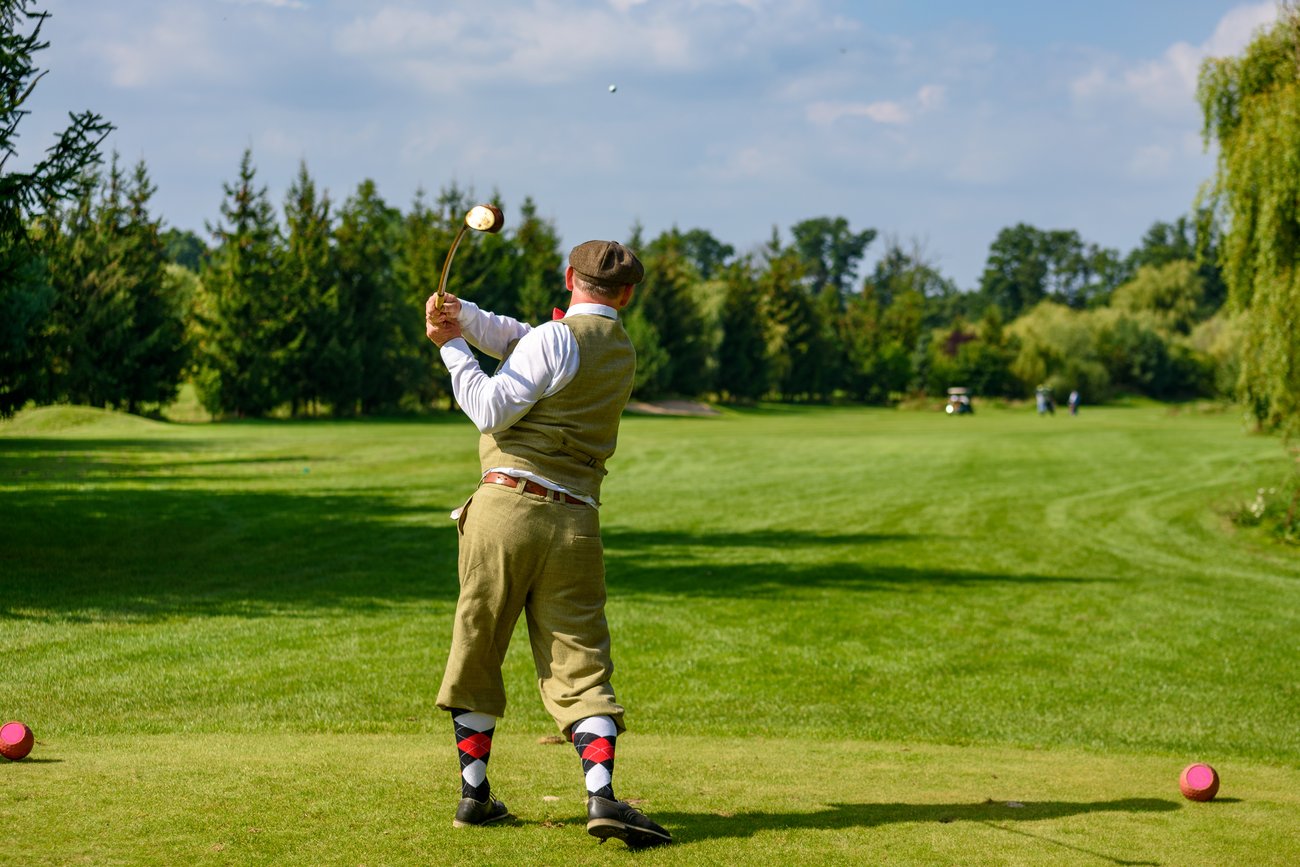
The 5-wood is swept, not hit into the grass like an iron. Ball position just in front of the center of the stance, shallow angle of attack, smooth swing. Anyone trying to take a divot usually hits fat and loses distance — the most common error pattern in a senior golfer's bag.
Tip 2 – The shaft decides, not the brand
⚠ Buying a stiff board under 90 mph is a bad purchase.
Pre-configured sets often have stiff shafts because it sounds „higher quality” in sales. For senior clubhead speeds under 90 mph, R-flex (regular) is suitable, and for speeds under 80 mph, Senior-flex is often appropriate. The conversion costs 80-150 € and realistically brings five to ten meters more carry—the biggest single distance lever on the club. It's more important than any new head model.
Tip 3 — Full swing from the rough, not cautious
✓ TRUST IN THE LOFT.
From the fairway, the 5-wood tempts cautious, delayed swings. Wrong: a smooth, full swing with a slightly steeper angle. The loft takes power from the turf, and the ball goes high and long. Lost distance due to „caution” is the second most common mistake with a 5-wood.

If a senior golfer can only carry one fairway wood, it should be a 5-wood. Nothing else covers as many situations for as many players.

— Tom Wishon, custom club designer and author The Search for the Perfect Golf Club

Three principles—and where they have a limit.

Versatility as a core strength

Fairway, rough, par-3 tee shot, par-5 layup — the 5-wood covers four standard situations. No other club in a senior's bag is as versatile. That's precisely where its value lies, not in a single stellar performance.

Shaft beats model

A suitable senior shaft in last year's model often provides more carry and consistency than the brand new premium model with a standard shaft. The leverage is at the grip end, not the head.

No universal remedy

When facing a headwind, a 3-wood is superior to a standard wood. From thick rough, a 4-hybrid is often the safer choice. In front of the green, it remains a wedge. Anyone who fills all their bag slots with 5-woods gains versatility in one area and loses it everywhere else.

Common Misconceptions and Marketing Traps

Misunderstanding 1 — „Anyone who has hybrids doesn't need a 5-wood”
Half-truth. A 4-hybrid and a 5-wood are close in loft (around 22° vs. 18°), but they fly very differently: the hybrid lower and with more roll-out, the 5-wood higher and with a softer landing. For firm, fast greens, the wood often wins; for headwinds and rough, the hybrid often wins. Having both is often the best combination for senior bags – not one or the other.
Misunderstanding 2 - „Stiff shafts are for strong players”
Simplification. What determines the shaft is not muscle power, but clubhead speed—and speed cannot be trained with biceps. A well-trained 68-year-old with 82 mph doesn't need a stiff shaft; a 45-year-old with 105 mph does. The „for strong players” approach is sales talk, not fitting reality. The number on the launch monitor decides.
Misunderstanding 3 - „New model = more distance”
Wildly exaggerated. The realistic distance difference between two current fairway wood generations is two to four meters — with perfect customization, under ideal conditions. A previous year's or two-year-old model with a suitable senior shaft (€100–€200 used) almost always beats a premium model with a standard shaft (€600 new) in practice. The marketing message „faster, further” sells, but reality is much more moderate.

On this page

ON THIS PAGE
01 Where the 5 wood truly wins
02 Three honest tips
03 Marketing traps
04 What the 5-wood doesn't replace
MS
Mathias Struwe
PUBLISHER · HCP 31 · 68 YRS.
140–170 m
realistic median range for senior golfers.
REFERENCE
Wishon, T. (2019): The Search for the Perfect Golf Club. TrackMan Performance Database 2024. Independent Fitting Evaluations 2023–2024. USGA Distance Insights Report 2023. German Sport University Cologne, Institute for Training Science (Golf Application).

What the 5-wood doesn't replace

The 5-wood is the most versatile fairway club in a senior golfer's bag. However, it neither replaces the 3-wood off the tee, nor the wedges around the green, nor a suitable hybrid for thick lie situations in the rough. It's an all-rounder, not a universal solution. For those who want to strategically fill their bag slots, the 5-wood serves as a solid foundation, and then they add clubs strategically where their own statistics indicate a need.


THREE FIRST STEPS

How to honestly optimize the 5 wood in 30 days

01
Check current shaft
At the PGA Pro or independent fitter: what shaft is in the current 5-wood? For Stiff and clubhead speed under 90 mph: convert to R or Senior. Realistic gain: 5-10 m more carry and significantly less dispersion.
02
Four-layer test
A practice session with the 5-wood from four lie types: fairway, semi-rough, rough, tee. Ten balls per lie. Record median distance and dispersion. Immediately shows which situation is reliable and which is not.
03
Practice sweep hits
Tee at normal height (not driver-high), 5-wood with a flat swing. Twenty balls. Goal: not the divot, but contact above the ground. Noticeably more consistent hits after 30 days.

Leave A Comment