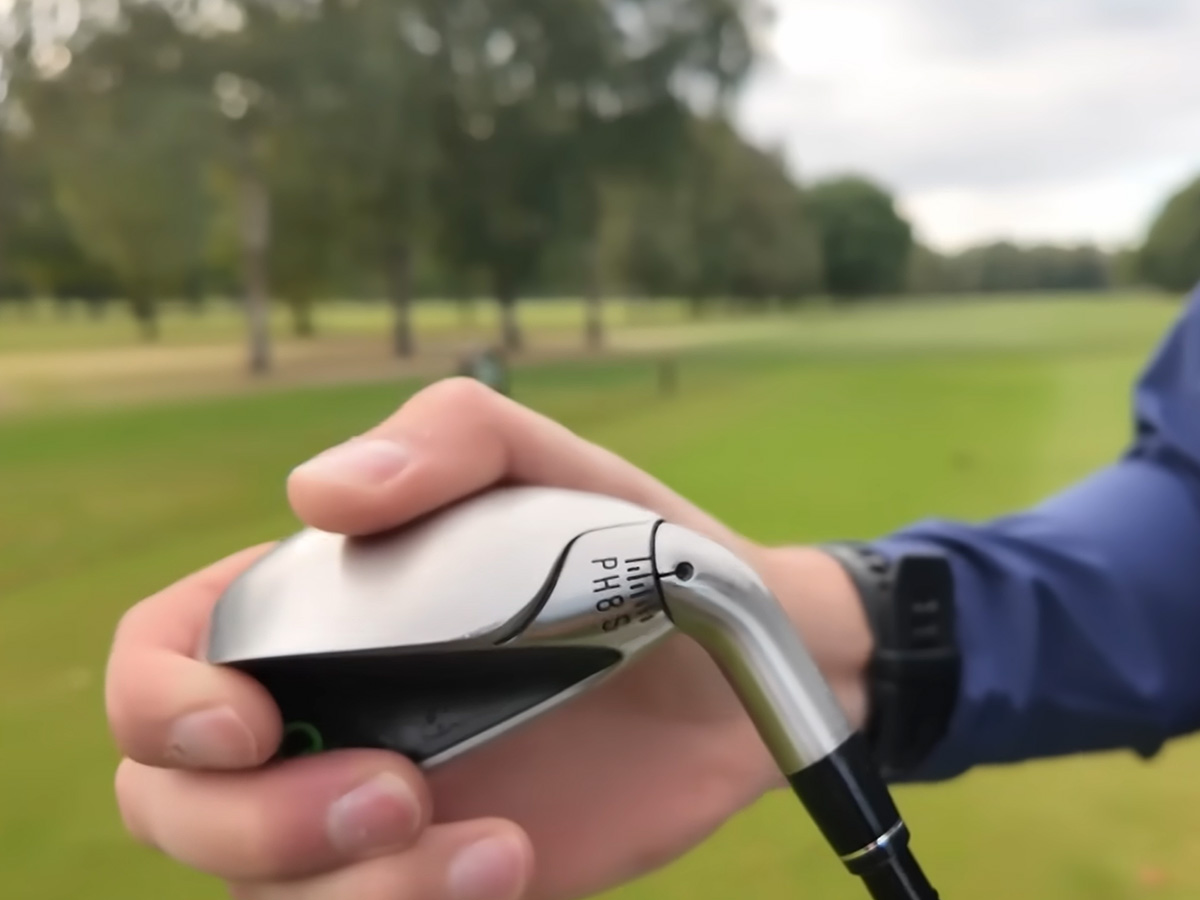
The bag setup is the invisible scoring decision in senior golf. Clubs remain in the bag because they've always been there — not because they demonstrably work. The driver is the most prominent example: emotionally charged, statistically no longer optimal off the tee for a significant portion of those over 65. The 2023 USGA Distance Insights Report repeatedly shows for amateur seniors with slower swings that the 3-wood and driver are often neck-and-neck in terms of reach and overall distance — with significantly better fairway hit rates for the wood. Nevertheless, almost everyone reaches for the driver. Those who examine this gain strokes without changing their swing.
Why the driver is often no longer optimal after 65
Point 1 — Spin loft balance tips at low speed
TOO LITTLE SPIN.
As clubhead speed decreases, the spin-loft balance shifts. A 9° or 10° driver at around 80 mph often produces only 1,900 to 2,200 rpm of backspin—too little for optimal hangtime. The result: a low trajectory, shorter carry, and unpredictable rollout depending on fairway conditions.
Point 2 - Error tolerance decreases
Off-center strains the driver.
Driver heads are optimized for high swing speeds. At slower swings, they lose disproportionately more ball speed on off-center hits. 3-wood heads are smaller but are more spin-efficient and often more forgiving of the more frequent off-center contacts.
Point 3 - Driving accuracy as a scoring lever
FAIRWAY PAYS OFF.
Champions Tour statistics show fairway hit rates from 65 to 72 percent. Amateur seniors are often at 35 to 45 percent. Each missed fairway costs an average of about 0.3 strokes (Broadie: Every Shot CountsA 3-wood change that raises the hit rate by ten points typically saves one to two strokes per round.
Item 4 — For some seniors, the 3-wood continues
✓ USGA DATA – CAREFULLY READ.
The USGA Distance Insights Report shows a recurring pattern for amateur seniors with slow swings: 3-wood and driver distances are often very close, and in some cases, the 3-wood even goes further. The exact percentage varies depending on the sub-segment; the pattern is stable. If you find yourself in this group, you should measure it—don't assume.
Item 5 — Emotional Bag Logic
SELF-IMAGE BEATS SCORE.
Putting away the driver feels like a defeat. That's the emotional baggage logic — and it regularly costs strokes. Those who understand the 3-wood as a „fairway finder for long holes” instead of a driver replacement make the decision more easily — and incrementally.
Three tests for the tea-club decision
Test 1 – Range-Test 10 vs. 10
✓ AN EXERCISE UNIT.
Ten drivers, ten 3-woods off the tee. Record median distance and dispersion (highest minus lowest distance). If the 3-wood goes as far or farther and disperses significantly less: a clear candidate for switching. A home launch monitor like the Garmin R10 is sufficient for this comparison.
Test 2 — Three Laps on the Track
✓ STATISTICS INSTEAD OF FEELINGS.
Round 1: Driver only off the tee. Round 2: 3-wood only. Round 3: Free choice. Record fairway hit percentage and gross score. Three rounds are enough to see if the 3-wood hits more fairways—and if the missing 10 yards actually make a difference in the score. For many players, the answer is disappointingly clear.
Test 3 — Launch Monitor Hour at Independent Fitter
SPIN-LOFT OPTIMIZATION.
If the driver produces less than 2,400 rpm of spin at the current clubhead speed, it is not optimally configured. Options: Loft up to 11–12°, different shaft, switch to a 3-wood off the tee. Important: Independent fitting — Manufacturer studios rarely sell switching away from their own brand.
The bag is the most underrated scoring tool in senior golf. Most players keep clubs out of emotional attachment, not because they actually produce better results.
— Tom Wishon, custom club designer and author of The Search for the Perfect Golf Club
Three principles for senior bag optimization.
Data beats habit
Bag decisions are usually made based on gut feeling and tradition. An honest launch monitor session once a year shows which clubs actually produce scores—and which just occupy bag slots.
Fairway hits carry
Extra yards that land in the rough or bunker are worthless. Fairway hit percentage is a more robust score predictor than pure tee distance. Ten yards shorter, but on the fairway, beats ten yards longer in the rough.
Spin beats speed
At lower swing speeds, backspin is the dominant distance factor. Higher lofted drivers, 3-woods, and in some cases mini-drivers, all utilize the same physics: more spin equals more hang time equals more total distance.
Common Misconceptions and Marketing Traps
Misunderstanding 1 – „The driver must be in the bag”
Convention Trap. There is no rule, no recommendation, and no statistical reason why a driver must be in every bag. Someone who reliably hits their 3-wood onto the fairway and regularly aims their driver into the rough will mathematically achieve a better score without a driver. The convention „driver = men's golf” is culture, not physics.
Misunderstanding 2 — „Mini-driver solves the problem”
Half-truth. Mini-drivers (250–305 cc, 11.5–13.5° loft) are a new manufacturer category with a sensible target audience — players seeking an intermediate option between a 3-wood and a driver. The marketing claim „delivers distance and control” is exaggerated; realistically, the mini-driver's performance lies between a lofted driver and a 3-wood, without clearly replacing either. An honest comparison on the launch monitor will determine if the new category is worth a bag slot.
Misunderstanding 3: „A new driver will result in more fairway hits.”
Only to a limited extent. Current drivers have higher tolerances and a larger sweet spot behavior — but the difference in fairway percentage between two generations rarely exceeds two to four percentage points. Someone who hits 35 percent fairways with the old driver will hit 37–39 percent with the new one — measurable, but not the promised miracle. The big jump is in club selection (driver vs. 3-wood), not in the model year.







 German
  English