TECHNOLOGY · SWING

Senior-Friendly Punching Technique — What changes after 60 (and what doesn't).

The classic golf swing is not unsuitable for seniors. But from age 60 onwards, it requires three structural adjustments that hardly any coach explicitly makes. What biomechanics really says — and where standard senior tips do more harm than good.

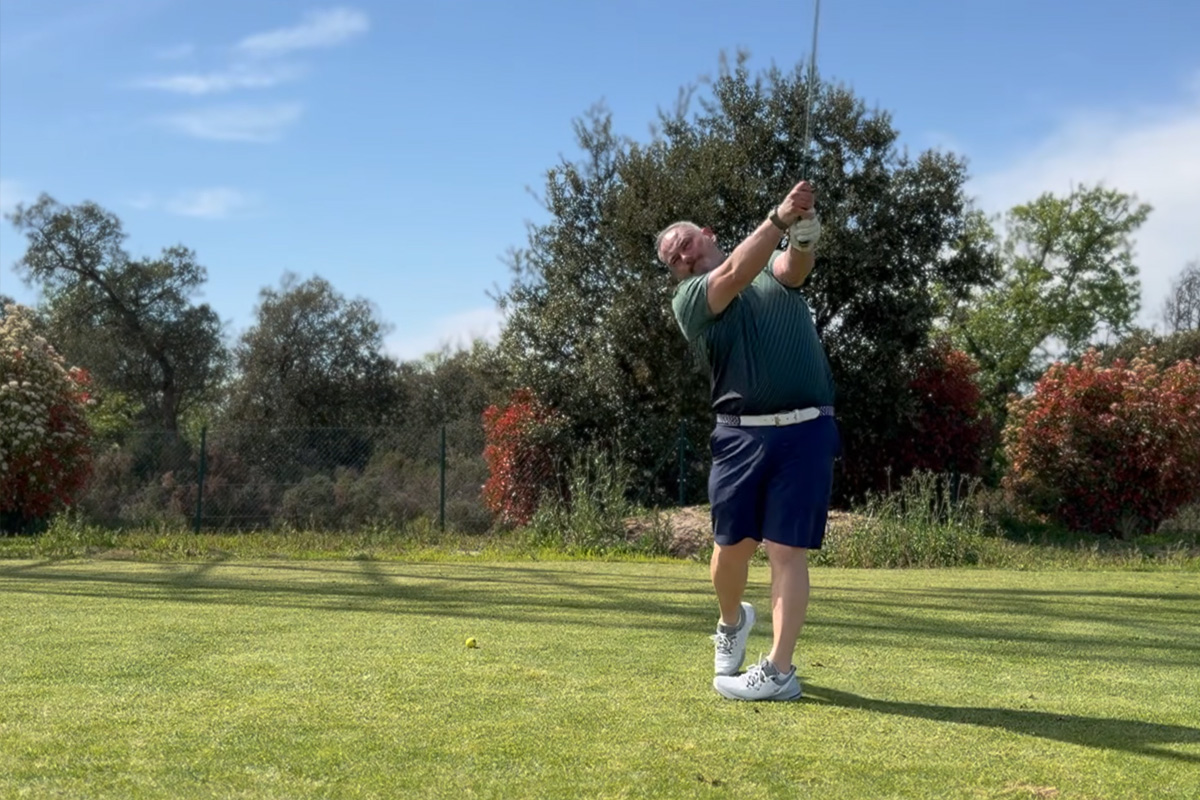
MAt 64, I changed coaches. My long classic swing was replaced by a supposedly „senior-friendly” compact variant: shorter backswing, more hands, less hips. Six weeks later, my score was 5 strokes worse, my shoulder hurt, and I understood: a senior swing isn't less swing, but a differently structured swing. The shortening was the problem—not the solution.

The classic „senior tips”—shorter swing, more hands, less hip rotation—are mostly biomechanically counterproductive. MyTPI research and Kelvin Miyahira analytics have shown for years: senior golfers don't need less movement, but rather better structured movement. The adjustments that really work are less spectacular than the marketing—and that's precisely why they've been working for twenty years.

What biomechanically really changes from age 60

Item 1 — Hip internal rotation decreases
5–10° PER DECADE.
Studies on Hip Mobility (Lamontagne 2021): Hip internal rotation decreases by an average of 5 to 10 degrees per decade of life after 50. Consequence: The backswing becomes shorter without conscious mobility work — not because the player wants to swing shorter, but because the structure forces it.
Point 2 - Thoracic spine mobility decreases
✗ 8–15° ROTATION LOST.
Thoracic spine rotation is crucial in the golf swing for the shoulder-to-hip difference (X-factor). From age 60, it typically decreases by 8 to 15 degrees. Those who don't actively counteract this loss compensate with their hips or shoulders, both of which lead to injuries.
Point 3 - Tendon elasticity decreases
⚠ Lag is slowly disappearing.
The elasticity of tendons—the basis of „lag” in the downswing phase—decreases with age. Junior tour players generate lag through stretch-shorten cycles. Senior golfers must consciously create lag rather than relying on reflexive elasticity.
Point 4 - Reaction Time + Speed
MAXIMUM SPEED REDUCED.
Maximal reaction velocity (stretch-shorten cycle) decreases with age by approximately 8 to 12 percent per decade. This has a direct effect on clubhead speed during a driver swing. The commonly cited 12 percent loss of distance after age 60 is physiologically explained precisely by this factor.
Point 5 — Balance and Setup Stability
✓ MORE CRITICAL THAN BEFORE.
Proprioception (body awareness) and balance decrease with age. Consequence: Setup stability becomes more important than for younger players. A slightly unstable stance costs senior golfers measurably more distance and accuracy than equivalent younger players.
12 %
Distance loss in senior golfers is explained solely by a lack of hip internal rotation
Lamontagne et al. (2021): Senior Golf Biomechanics
Mobility work resolves this deficit—no momentum reduction.

Three swing adjustments that really work from age 60

Adjustment 1 — Extended Setup Phase
✓ 3 MORE SECONDS OF STABILITY.
Instead of a fast pre-shot routine tempo: consciously add 3 extra seconds at setup. Normalize breathing, check balance (50/50 weight distribution), test shoulder rotation. Sounds small, but it's the lever with the highest score impact — because an unstable setup directly translates to dispersion from 60 yards onwards.
Adjustment 2 - Wider Stance + slight hip internal rotation
More base, more rotation.
Stand about 2 centimeters wider than classically recommended. Hips already rotated 5 to 10 degrees in the target direction at address. This increases the effective range of motion and restores the hip internal rotation that is structurally missing from age 60 onward. Immediately implementable.
Adjustment 3 — Lead-leg-dominated downswing
✓ NO CLASSIC „HIP BUMP”.
The classically taught „hip bump” (hip shift towards the target) is often counterproductive for senior golfers. Instead: the downswing is initiated by building pressure in the lead leg. This protects the lumbar vertebrae and produces more efficient energy transfer at slower swing speeds.
Bonus—Reduce knee flex in the backswing
⚠ ONLY IF MOBILITY IS LACKING.
If mobility work is permanently not possible: Consciously limit the turn in the backswing to 75 percent of maximum amplitude. However, this only works as a last resort – mobility work is structurally better because it restores full amplitude.
Bonus — Prioritize Head Stability
Keep your eyes on the ball.
As balance control decreases, head stability during the swing becomes more critical. Keep your eyes consciously on the ball until the swing passes the impact area. Do not „look up” to observe the ball's flight. This sounds simple yet measurably improves accuracy for senior golfers.

There’s no such thing as a senior golf swing. There’s only good biomechanics and bad biomechanics—and seniors have less margin for error with bad biomechanics than younger players.

— Dr. Greg Rose, Co-founder of the Titleist Performance Institute (MyTPI)

Three Principles That Distinguish Truly Senior-Friendly Technology from Marketing Gimmicks.

Mobility beats shortening

The classic senior tip „shorter swing” treats the symptom, not the cause. Daily hip, thoracic spine, and shoulder mobility restores full range of motion – and with it, distance that a compact swing could never deliver.

Setup stability beats dynamics

Young players compensate for an unstable setup with dynamic athleticism. Senior golfers cannot do that. A stable base at address and a quiet setup phase are the most important technical requirements in senior golf – more important than any swing mechanics detail.

Efficiency beats maximum

Maximum clubhead speed decreases with age — efficiency does not. Smash factor, spin loft balance, clubface control: all trainable, all available from age 60 onwards. Those who swing for efficiency instead of maximum score measurably better — and spare their joints.

On this page

ON THIS PAGE
01 What biomechanically really changes from age 60
02 Three swing adjustments that work
03 What technical work cannot replace
MS
Mathias Struwe
PUBLISHER · HCP 31 · 68 YRS.
12 %
Distance loss solely due to insufficient hip rotation.
REFERENCE
Lamontagne et al. (2021): Senior Golf Biomechanics. MyTPI (2020): The Body-Swing-Connection. Miyahira, K.: Real Spin Loft Theory. Rose, G. & Phillips, D. (2018): The Golf Body. International Society for Golf Medicine 2023.

What technical work cannot replace

Three swing adjustments are the most sustainable technical score levers — but they neither replace mobility work nor short game routine. Those with perfect swing technique who play wedges poorly and do not follow a daily mobility program are forfeiting the greater part of the possible score advantage. Technique is the prerequisite — not the entire game. It only takes effect in combination with body-first training and short game discipline.

THREE FIRST STEPS

How to Establish Senior-Friendly Technology in 30 Days

01
Extend setup phase by 3 seconds
Take an extra 3 seconds for your pre-shot routine in the next round. Normalize your breathing, check your balance, and test your shoulder rotation. The score improvement is measurable in a single round—usually 2 to 4 strokes less.
02
Wider Stance + Hip External Rotation Test
In the next practice session: 20 balls with a normal stance, 20 balls with a 2 cm wider stance and 5-10° hip internal rotation. Compare median carry and dispersion. For most senior golfers, both improve measurably.
03
Mobility Audit as a Prerequisite
Before you tinker with your technique: MyTPI screening with a certified coach. Without sufficient hip and thoracic spine mobility, swing adjustments will be.

Leave A Comment